Covered Call Screeners Compared: Screening vs Automated Execution
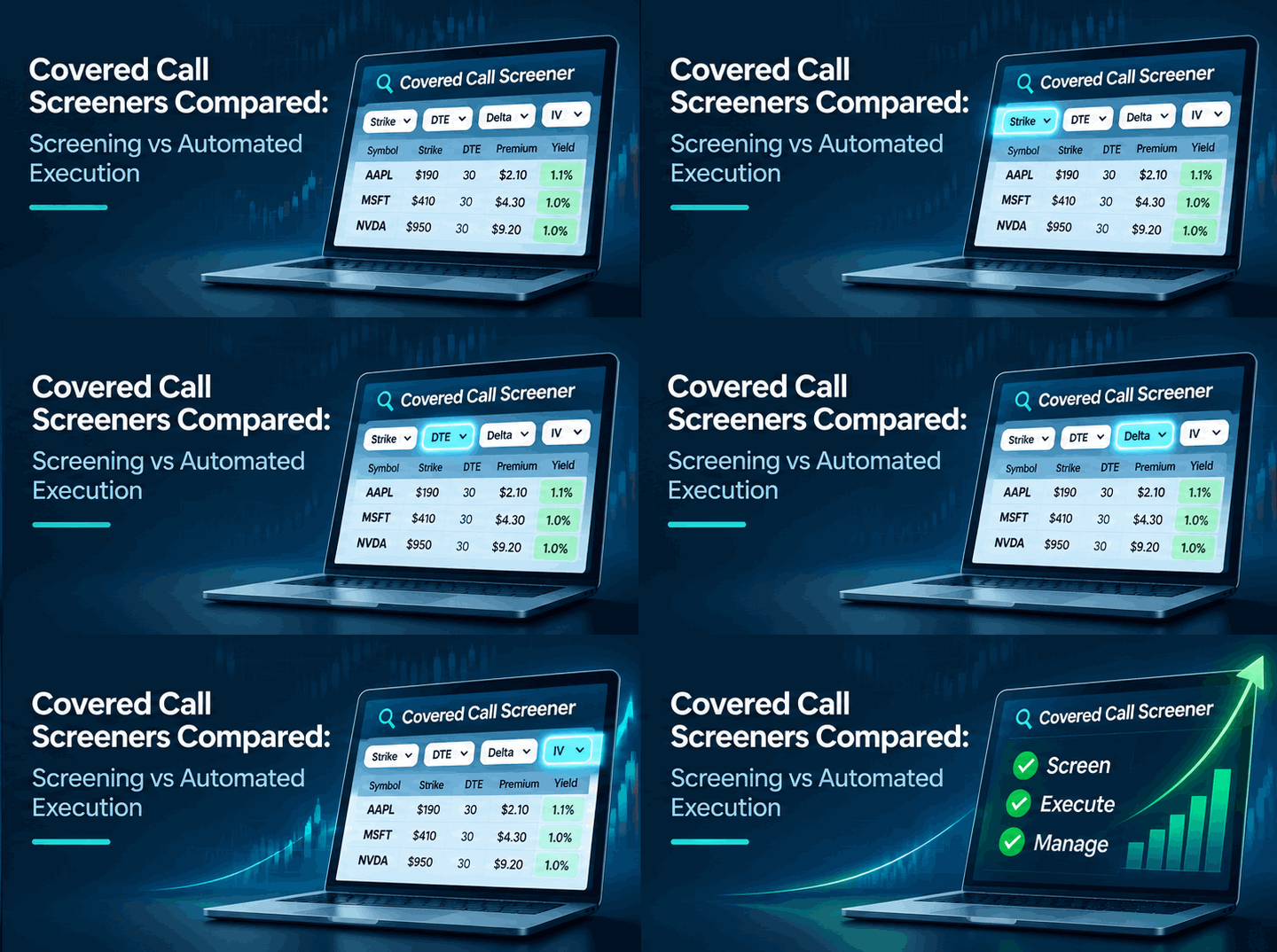
Compare covered call screeners, key filters, and automated execution. Learn how AcuBooth manages covered calls.
A covered call screener helps you find call options worth considering based on premium, strike price, expiration, and risk. Barchart, Market Chameleon, Born To Sell, and Option Samurai all offer ways to search for potential trades. Some focus on finding opportunities across the market, while others offer portfolio tracking and tools for evaluating existing positions.
The next question is what happens after you've found a call you want to sell. Most screeners leave order placement and ongoing management to you. AcuBooth takes a different approach, using predefined rules to screen, execute, and manage covered calls on eligible shares already held in client accounts.
Here's how the tools compare, which filters deserve attention, and when automated execution makes more sense than screening alone.
What Does a Covered Call Screener Actually Do?
Say you own 500 shares of a stock and want to sell calls against part of the position.
You could open the option chain, compare strikes and expiration dates, check the available premiums, and review each contract's trading activity. A covered call screener organizes that information and lets you narrow the choices.
You might look for calls expiring within a month, with strikes above the current stock price and enough liquidity to trade without an excessive bid-ask spread.
The results give you contracts to investigate. They don't tell you whether selling the call is appropriate for the underlying investment.
For instance, a high-premium call on a volatile stock might look attractive until you consider the possibility of a 20% decline. The call premium would offset only part of that loss.
Covered Call Screeners Compared
The best covered call screener depends on whether you're searching the market for trade ideas or managing calls against positions you already own.
| Platform | What It Offers | Where It Fits |
|---|---|---|
| Barchart | Covered call rankings, customizable filters, return estimates, and market data | Searching for potential trades across stocks |
| Market Chameleon | Covered call screening, volatility research, historical analysis, and event filters | Examining premiums alongside market conditions |
| Born To Sell | Covered call searches, portfolio tracking, income planning, and roll comparisons | Managing an active covered call portfolio |
| Option Samurai | Multi-strategy scans, options Greeks, volatility filters, and custom searches | Researching covered calls alongside other strategies |
| AcuBooth | Rules-based screening, execution, monitoring, rolling, and reporting | Managing covered calls on eligible existing holdings through an advisor overlay |
Barchart is a useful starting point for a broad search. It displays potential returns and lets users filter results. Its standard screener data may be delayed, and certain advanced features require Premier access.
Market Chameleon is worth considering when you want to investigate volatility, earnings, and past market behavior alongside a quoted premium.
Born To Sell is more focused on covered call investors. Its portfolio tools show existing positions, remaining time premium, and possible adjustments. Its Roll Me feature helps compare replacement calls.
Option Samurai supports covered calls and numerous other option strategies. It suits investors who want to build more detailed searches rather than focus exclusively on call writing.
AcuBooth works differently. It isn't intended as a general-purpose marketplace for finding stocks to buy. Its screening process operates within an automated covered call program for eligible shares in connected Schwab accounts.
How to Screen Covered Calls on Stocks You Already Own
Start with the shares, not the premium.
If you wouldn't be comfortable continuing to own a stock after a sharp decline, its option premium shouldn't persuade you to buy it merely to sell calls.
For an existing holding, these are the filters worth checking.
| Filter | What to Review |
|---|---|
| Strike price | Would you be comfortable selling the shares at this price? |
| Expiration | How long will the call limit upside participation? |
| Delta | How sensitive is the call to stock movements? |
| Bid-ask spread | Can you execute near a reasonable quoted price? |
| Open interest and volume | Is there sufficient trading activity? |
| Implied volatility | Is the premium reflecting unusual expected movement? |
| Earnings date | Could an announcement cause a large price change? |
| Ex-dividend date | Is early assignment a relevant concern? |
There isn't one delta or expiration range that works for every portfolio.
A client with a highly appreciated position they want to retain may prefer more room between the stock and strike. Another client who is happy to sell at a target price might accept a closer strike for additional premium.
For a closer look at those choices, read AcuBooth's covered call strike selection guide.
How to Compare Results From a Covered Call Screener
Suppose you own 100 shares purchased at $100 each.
A covered call option screener returns two hypothetical contracts, both expiring in 30 days.
| Call A | Call B | |
|---|---|---|
| Current stock price | $100 | $100 |
| Strike | $105 | $110 |
| Bid premium | $1.80 | $0.70 |
| Premium for 100 shares | $180 | $70 |
| Premium as % of stock value | 1.8% | 0.7% |
| Effective gross sale price if assigned | $106.80 | $110.70 |
Call A pays $110 more upfront. But it also limits the stock's upside at a lower strike.
If the stock rises to $120 and the shares are assigned, the difference is substantial.
What Happens at Expiration?
| Stock Price | Call A: $105 Strike | Call B: $110 Strike | Stock Without Call |
|---|---|---|---|
| $90 | −$820 | −$930 | −$1,000 |
| $100 | +$180 | +$70 | $0 |
| $105 | +$680 | +$570 | +$500 |
| $120 | +$680 | +$1,070 | +$2,000 |
Combined stock and option results, assuming a $100 share purchase price, expiration settlement, and no fees or dividends.
Call A produces the larger premium when the stock stays flat. Call B allows another $500 of stock appreciation before upside becomes capped, in exchange for collecting $110 less upfront.
At $120, Call B finishes $390 ahead of Call A. But both underperform simply holding the stock.
The useful comparison isn't which call pays the highest premium. It's which sale price and payoff profile fit the investor's plans for the shares.
Why Annualized Returns Can Mislead
Many screeners show annualized potential returns. Those figures help compare contracts with different expirations, but they aren't forecasts.
Take Call A from the example.
Its $180 premium represents 1.8% of the $10,000 stock position.
A simple annualization produces:
1.8% × (365 ÷ 30) = 21.9%
That doesn't mean the position is expected to earn 21.9% over the next year.
The calculation assumes comparable opportunities can be repeated. In practice, the stock moves, volatility changes, premiums fluctuate, and calls may need to be closed at a cost.
Nor does 21.9% account for losses on the underlying shares.
This is especially important when researching the highest-yield covered calls. Unusually large premiums can reflect earnings uncertainty, greater implied volatility, or strikes that leave little upside.
Before relying on a screener's return estimate, check whether it uses the bid, ask, midpoint, or last traded price. A quoted premium isn't necessarily the price your order will receive.
AcuBooth discusses this distinction in its article on bid-ask spreads and slippage.
What Happens After You Sell the Call?
Suppose you sell Call A for $180.
The stock rallies, and the option now costs $290 to buy back. Closing it creates a $110 realized option loss.
You might sell another call at a higher strike for $230. That produces a new cash credit, but the replacement call remains an open obligation.
Your running option cash flow is:
$180 − $290 + $230 = $120
That $120 isn't final option profit. The new call still has to expire, be closed, or be settled through assignment.
A screener can help compare replacement contracts. But someone must decide whether to close the original call, select the new strike, place the orders, and review the effect on the client's shares.
For an advisor managing dozens of positions, those decisions recur throughout the trading cycle.
Where Screening Ends and Automated Execution Begins
Screening tools and automated covered call software overlap in some research functions. The difference becomes clearer after a contract is selected.
| Task | Screener-Based Workflow | AcuBooth |
|---|---|---|
| Find candidate calls | User reviews filtered results | Rules evaluate eligible holdings |
| Decide which shares participate | Investor or advisor | Advisor sets eligible positions and share caps |
| Place orders | Separate trading step | Rules-based automated execution |
| Monitor open calls | Manual reviews or available alerts | Monitors positions during trading sessions |
| Evaluate rolls | User compares and acts | Rule-driven position management |
| Record executions | Depends on platform and brokerage | Execution history and overlay reporting |
| Manage core investments | Investor or advisor | Advisor retains control |
Automation doesn't eliminate market risk or make every execution profitable. Its purpose is to carry out a defined process without requiring the advisor to manage each option trade individually.
The rules, position limits, and reporting therefore matter just as much as the screening capability.
How AcuBooth Screens and Manages Covered Calls
AcuBooth is designed for registered investment advisors and wealth managers who want to operate a covered call program against existing client equity holdings.
Rather than asking an advisor to search the market for high-premium stocks, it works with eligible positions the advisor has approved.
The process includes:
-
Position selection: Advisors choose which eligible holdings participate and set limits on how many shares can be covered.
-
Contract evaluation: AcuBooth screens available calls using predefined conditions, including strike, expiration, and market-related parameters.
-
Execution: The system submits covered call orders through supported Schwab account arrangements.
-
Position management: Open calls are monitored, with closing and rolling decisions handled according to the applicable rules.
-
Reporting: Advisors can review execution records, premiums, and activity within the overlay.
The program uses deterministic rules rather than AI stock-price predictions. Each execution decision can be traced to the rule that triggered it.
AcuBooth manages only the covered call overlay. The advisor remains responsible for the underlying portfolio, client suitability, and investment decisions.
The platform's How It Works page includes examples of its strike and roll evaluation process.
Explore AcuBooth for Advisors to review account eligibility, controls, and how the covered call overlay works with existing Schwab holdings.
Frequently Asked Questions
Is there a free covered call screener?
Yes. Several platforms provide limited free screening or trial access. However, advanced filters, timely market data, alerts, and portfolio features may require a subscription. Check current access terms before choosing a tool.
Can a covered call screener place trades automatically?
Some specialized platforms support automated execution, but a research screener alone typically doesn't. AcuBooth combines covered call screening with automated execution and position management for eligible accounts.
Does a higher covered call yield mean a better trade?
No. Higher premiums can reflect greater volatility, event risk, or a closer strike. Evaluate the full stock-and-option position, including possible losses, capped upside, and execution costs.
Does AcuBooth replace a covered call screener?
For eligible holdings within its advisor overlay, AcuBooth handles screening as part of a broader execution process. It isn't intended to replace general market research tools used to discover stocks or evaluate unrelated options strategies.
Stay ahead on covered call strategy
Insights, market commentary, and updates from the AcuBooth team — delivered to your inbox.