Covered Put Explained: How Selling Covered Puts Works
What a covered put is, how it works, its profit/loss and breakeven math, and how this bearish strategy differs from a covered call.
What Is a Covered Put? A Beginner's Guide to Selling Covered Puts
A covered put is a bearish options strategy that combines a short stock position with a sold put option on the same security.
It generates upfront premium income to lower the cost basis of a short trade, but it comes with capped profit potential and unlimited risk if the stock price rises.
If you currently own shares in your portfolio and want to generate extra yield, a covered put is not the right strategy, you are looking for a covered call instead.
What is a Covered Put?
A covered put has two legs executed simultaneously: shorting 100 shares of stock and selling one put option contract on that same stock.
Selling the put generates upfront premium income. That premium reduces the overall cost basis of the short position and shifts your breakeven point higher.
What "Covered" Means?
-
Options Obligation: "Covered" means the short stock position offsets the option obligation.
-
Assignment Process: If the put is assigned, shares are automatically purchased at the strike price to close out your short position.
-
Vs. Naked Put: A naked put has no underlying short stock position attached to it.
-
Vs. Cash-Secured Put: A cash-secured put uses reserved cash.
-
No Downside Safety: "Covered" does not mean protected. A short stock position carries unlimited loss potential if the underlying asset rallies.
Risk Alert: The term "covered" applies exclusively to the option contract obligation. The underlying short stock position has no upside cap. If the stock price rises sharply, losses on your short position can accumulate without limit.
How a Covered Put Works: Step by Step
A covered put trade unfolds across distinct operational phases depending on market movement.
| Step | Action | What Happens |
|---|---|---|
| 1 | Short 100 shares of stock | Profit if the stock falls; lose if the stock rises. |
| 2 | Sell 1 put contract (below market price) | Collect premium upfront; widens breakeven point. |
| 3 — Best Case | Stock falls to put strike at expiration | Put expires worthless; keep full premium plus short stock gains. |
| 4 — Put Assigned | Stock falls below strike before/at expiration | Required to buy shares at strike; short position closes; keep premium. |
| 5 — Worst Case | Stock rises sharply | Short stock position incurs uncapped losses; premium only provides minor offset. |
Covered Put Profit, Loss, and Breakeven
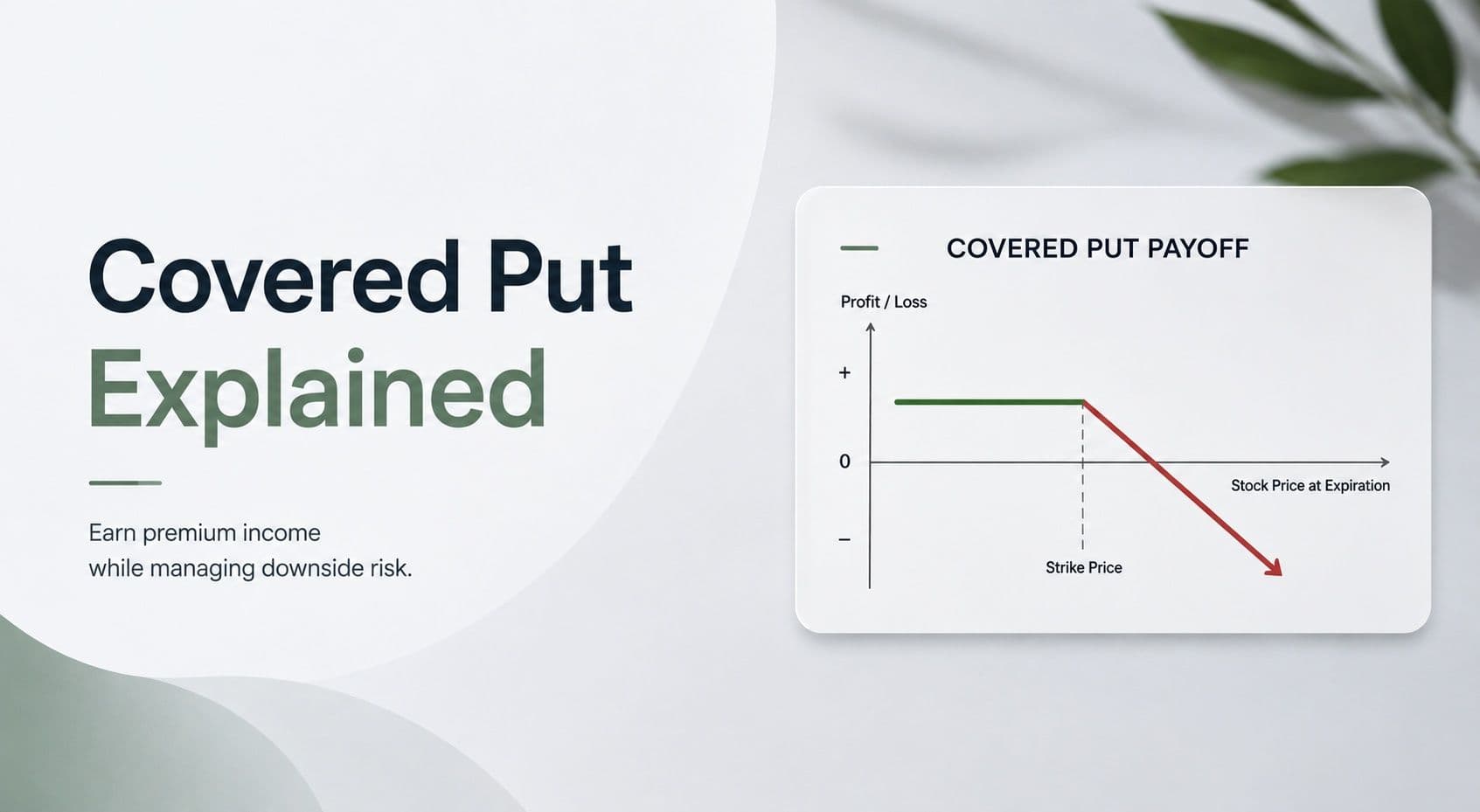
Profit on a covered put is capped at the selected strike price. Once the stock falls below the put strike, the short put incurs losses that offset any further gains on the short stock.
Profit & Loss by Scenario
| Scenario | Stock Direction | Outcome |
|---|---|---|
| Max Profit | Falls to put strike | Option premium + short stock gain from entry down to strike. |
| Neutral | Stays flat | Keep full option premium; short stock is approximately breakeven. |
| Put Assigned | Falls below strike | Short position automatically closes at the strike price; keep option premium. |
| Max Loss | Rises sharply | Unlimited loss on the short stock position; option premium offers minimal protection. |
Key Numbers
-
Max Profit: Premium received + (Short stock entry price − Put strike price)
-
Max Loss: Unlimited (no ceiling on short stock losses if the stock rallies)
-
Breakeven: Short stock entry price + Premium received
-
Risk Profile: Asymmetric profile featuring capped upside return and unlimited downside exposure.
Covered Put vs. Covered Call
These two strategies share a naming structure but operate in opposite market directions. One is bearish and requires margin, while the other is bullish and requires basic options approval.
| Feature | Covered Put | Covered Call |
|---|---|---|
| Stock Position | Short 100 shares | Long 100 shares (you own the stock) |
| Option Sold | Short put option | Short call option |
| Market Outlook | Bearish to neutral | Bullish to neutral |
| Max Profit | Capped at put strike | Capped at call strike |
| Max Loss | Unlimited (if stock rises) | Limited (if stock falls to zero, minus premium) |
| Margin Required | Yes | No (Tier 1 options approval only) |
| IRA / Retirement | Not permitted (IRS prohibits short sales in IRAs) | Permitted in most IRAs |
| Execution Complexity | High (requires short position & margin oversight) | Low (most accessible strategy for equity holders) |
| Retail Accessibility | Advanced traders only | Standard entry point for options |
| RIA Portfolio Fit | Rare (requires full unlimited-risk documentation) | High (standard yield-overlay strategy) |
| Automated Execution | No | Yes (via AcuBooth) |
How AcuBooth Works?
The Advisor
-
Evaluates client suitability for covered call overlay strategies.
-
Selects eligible client positions and configures account parameters at onboarding.
-
Retains complete fiduciary responsibility, client relationship management, and billing control.
-
Monitors sleeve performance via the AcuBooth advisor portal without managing individual option orders.
The Client
-
Signs the AcuBooth overlay authorization and custodian service agreements.
-
Secures Tier 1 (basic) options approval on their Charles Schwab account.
-
Acknowledges standard options risks, including capped upside and assignment possibilities.
AcuBooth
-
Scans, evaluates, and executes covered calls using its deterministic rules engine.
-
Monitors open positions continuously and manages roll decisions within advisor-set limits.
-
Delivers comprehensive trade logs and compliance reporting to the firm and custodian.
The Custodian
-
Maintains physical custody of all client securities, cash, and option positions.
-
Clears and executes transactions generated via the AcuBooth trade interface.
-
Generates official trade confirmations, monthly statements, and annual tax documents (Form 1099).
Conclusion
AcuBooth lets advisory firms run automated covered calls directly inside client Schwab accounts. You keep full portfolio control while removing manual trading hassle and administrative friction.
Schedule a demo with AcuBooth today to smoothly grow your advisory practice.
Related Articles
Stay ahead on covered call strategy
Insights, market commentary, and updates from the AcuBooth team — delivered to your inbox.